Soil Nailing for Slope Protection During the Rainy Season
Soil nailing slope protection in the rainy season: how nails, shotcrete and drainage work, plus construction tips and an FAQ for contractors.

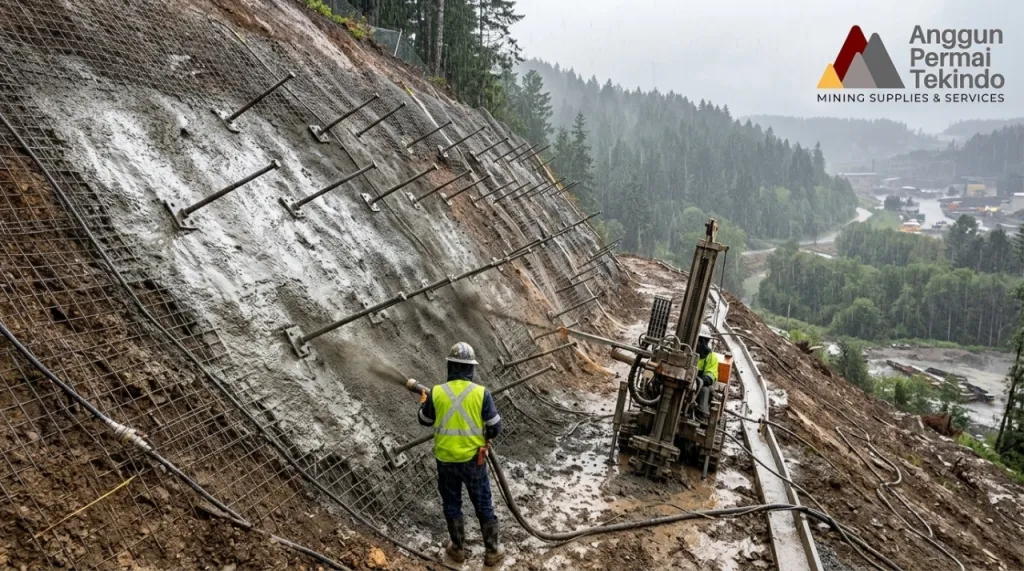
Soil nailing protects slopes during the rainy season by reinforcing the soil with steel nails and shotcrete. Drainage, including surface drains, weep holes, and horizontal drains, reduces pore water pressure caused by rainwater infiltration. Its effectiveness depends on designing for saturated conditions, controlling water during construction, and monitoring the slope.
Contents
- Key Takeaways
- Introduction
- Why Does Rain Endanger Slopes?
- What Is Soil Nailing?
- How Does Soil Nailing Protect Slopes in the Rainy Season?
- Soil Nailing Design for Rainy Conditions
- Managing Soil Nailing Work in the Rainy Season
- Supporting Technical Data and Facts
- Case Studies (Illustrative Examples)
- Advantages and Disadvantages
- Practical Tips and Recommendations
- FAQ (Frequently Asked Questions)
- Conclusion
Key Takeaways
- Rain triggers landslides mainly by infiltrating the soil, which raises pore water pressure and lowers shear strength, and by surface erosion.
- Soil nailing reinforces excavated slope soil from within using grouted steel nails and a shotcrete facing.
- Soil nailing alone is not enough. A drainage system must be part of the design so water does not get trapped behind the facing.
- The design must account for saturated conditions and rainfall loads, not just dry conditions.
- The construction stage is the most vulnerable phase because the excavated slope is open. Excavation, nail installation, and shotcrete spraying must be scheduled around the weather.
- Quality control (nail pull-out testing, shotcrete quality, and weep hole condition) determines performance during heavy rain.
- Monitoring and maintenance after rainfall keep the slope safe.
Introduction
The rainy season is always a critical period for slopes in Indonesia. The National Disaster Management Agency (BNPB, Badan Nasional Penanggulangan Bencana) classifies landslides as hydrometeorological disasters that recur every year, especially during periods of heavy rainfall. The Meteorology, Climatology, and Geophysics Agency (BMKG) issues weather information and early warnings, while the Geological Agency (Badan Geologi) regularly publishes forecasts of areas prone to ground movement. This information helps contractors and landowners prepare.
For contractors and project managers, there are two challenges: protecting existing slopes and keeping excavated slopes stable during construction. One solution widely used is soil nailing, which reinforces excavated slopes with steel nails and shotcrete.
However, soil nailing installed without accounting for rainwater can fail. This article explains how soil nailing works during the rainy season, how to combine it with drainage, how to manage work in wet weather, and offers practical tips. The content is educational. Design and construction must be carried out by competent geotechnical engineers.
Why Does Rain Endanger Slopes?
Rain endangers slopes because water seeps into the soil, raises pore water pressure, adds weight to the soil, and reduces shear strength, while surface runoff erodes the ground.
| Mechanism | Impact on the slope |
|---|---|
| Water infiltration | The soil becomes saturated and its unit weight increases |
| Rising pore water pressure | Effective stress drops, reducing shear strength |
| Loss of matric suction in unsaturated soil | Apparent cohesion is lost, and the soil moves more easily |
| Surface erosion | Gullies weaken the surface and the toe of the slope |
| Water-filled tension cracks | Water pressure in the cracks pushes the soil mass |
| Seepage at the slope toe | Risk of piping and soil loss |
What Is Soil Nailing?
Soil nailing is an in situ slope reinforcement technique that installs steel bars (nails) into the ground, grouts them, and then covers the surface with shotcrete and wire mesh, so the soil mass acts as a single, stronger unit.
The construction is top-down. The soil is excavated in stages, typically about 1 to 2 meters per stage. At each stage, nails are installed and shotcrete is sprayed before excavation continues. The method suits excavated slopes in cohesive soil, dense sand, or weathered rock. It is less suitable for embankments or very soft soil.
How Does Soil Nailing Protect Slopes in the Rainy Season?
Soil nailing protects slopes in the rainy season in three ways: it increases the soil's shear resistance, protects the surface from erosion, and, when combined with drainage, controls water inside the slope.
1. Increasing Shear Resistance and Stability
Nails embedded across potential sliding surfaces transfer tensile forces, making it harder for the soil mass to move, even when soil shear strength drops due to water saturation.
2. Protecting the Surface From Erosion and Shallow Failure
The shotcrete facing with wire mesh holds surface soil against rain-driven erosion and resists shallow sloughing between the nails.
3. Controlling Water Through an Integrated Drainage System
Shotcrete is nearly impermeable. Without an outlet, water can build up behind the facing and raise pore water pressure. For this reason, soil nailing that performs reliably in the rainy season is always equipped with:
- Surface drainage: channels at the crest of the slope (cut-off drains), berms, and at the toe to divert rainwater.
- Vertical geocomposite drains behind the shotcrete that carry water downward.
- Weep holes through the facing to release water.
- Horizontal drains (perforated pipes) installed into the slope to lower the groundwater table.
Soil Nailing Design for Rainy Conditions
Soil nailing design for slopes exposed to rain must check stability under saturated conditions and confirm that the factor of safety meets standards.
| Design aspect | Considerations for the rainy season |
|---|---|
| Soil parameters | Use saturated shear strength or a reasonable worst-case condition |
| Groundwater table | Assume the water table rises during extreme rainfall, based on field data |
| Factor of safety | Follow the requirements of SNI 8460 (Indonesian National Standard for geotechnical design), including short-term and long-term slope conditions |
| Construction stages | Check stability at each excavation stage, not only the final condition |
| Drainage | Design the capacity of channels, weep holes, and horizontal drains for the design rainfall discharge |
| Pull-out resistance | Verify through nail pull-out testing, accounting for the reduced soil strength when wet |
| Corrosion | Protect permanent nails (for example, with galvanizing, epoxy coating, or grout sheathing) |
Managing Soil Nailing Work in the Rainy Season
The construction stage is when the slope is most vulnerable, because the excavation face is open and not yet reinforced. The following practices help keep the work safe.
Before Work Begins
- Monitor weather forecasts from BMKG and information on potential ground movement from the Geological Agency for the project area.
- Prepare temporary drainage and water diversion channels before excavation starts.
- Prepare temporary covers (for example, tarpaulins or protective sheets) and pumps.
- Set rainfall thresholds or site conditions that require work to stop.
During Work
- Limit the length and height of open excavation. Complete nails and shotcrete for one stage before excavating the next.
- Protect the excavation face during rain. Do not spray shotcrete onto surfaces that are ponded with water, or during heavy rain that cannot be controlled.
- Install weep holes and drainage as soon as possible so water does not get trapped.
- Check the quality of grout and shotcrete. Rainwater entering the mix can change the water-cement ratio.
- Watch for early signs of movement: tension cracks at the crest, new seepage, or ground settlement.
After Heavy Rain
- Inspect channels, weep holes, and horizontal drains for blockages.
- Read monitoring points (survey pegs, inclinometers) where they are installed.
- Inspect the facing and the crest area for cracks and settlement.
- Report findings to the geotechnical designer before work resumes.
Supporting Technical Data and Facts
The following are general references. Final values depend on the results of the soil investigation and design.
- Slope factor of safety. SNI 8460, the Indonesian National Standard on geotechnical design requirements, sets minimum factors of safety for slopes. For long-term static conditions with high failure consequences, the factor of safety is generally around 1.5. Check the latest edition and tables.
- Nail length. The FHWA guidance (Geotechnical Engineering Circular No. 7: Soil Nail Walls) states that nail length is generally about 0.6 to 1.0 times the wall height.
- Nail spacing. Generally about 1.2 to 2 meters vertically and horizontally.
- Shotcrete thickness. Generally about 100 to 150 mm for permanent walls, depending on the design.
- Nail pull-out testing. FHWA guidance includes verification tests on test nails and proof tests on a portion of production nails, generally about 5 percent, loaded to a multiple of the design load as specified.
- The role of water. Rising pore water pressure from heavy rain is one of the most common triggers of landslides, so drainage must be included in the design.
- Disaster information. BNPB classifies landslides as hydrometeorological disasters, BMKG issues weather information and early warnings, and the Geological Agency publishes forecasts of areas prone to ground movement.
- Construction safety. Construction safety management follows the Construction Safety Management System (SMKK, Sistem Manajemen Keselamatan Konstruksi) under regulations from the Ministry of Public Works and Housing.
- Legal basis. Construction work is governed by the Construction Services Law (Law No. 2 of 2017, Undang-Undang Jasa Konstruksi), which requires construction safety and the competence of qualified professionals.
Case Studies (Illustrative Examples)
Note: The following scenarios are illustrations based on common practice. They are not data from any specific project.
Case 1: Road Cut Excavated at the Start of the Rainy Season
Conditions: A road-side cut about 8 meters high. Work took place at the beginning of the rainy season, and the soil was silty clay.
Solution: Soil nailing with a shotcrete facing, a cut-off drain at the crest, geocomposite drains, and weep holes. Excavation was limited to one stage per day, and shotcrete was sprayed immediately.
Expected result: The open excavation face was not left to absorb rain overnight, and water behind the facing had an outlet.
Lesson: Discipline in staged excavation and temporary drainage matters as much as the final design.
Case 2: Cracks at the Crest of a Slope Behind a Building After Rain
Conditions: After consecutive heavy rainfall, tension cracks appeared at the crest of a slope behind a building, and new seepage emerged mid-slope.
Solution: A soil investigation, followed by reinforcement with soil nailing, horizontal drains to lower the groundwater table, and improvements to surface drainage.
Expected result: The slope is stable with a factor of safety that meets standards under saturated conditions, and water is no longer trapped.
Lesson: Early signs such as cracks and seepage need prompt attention rather than waiting for a failure.
Case 3: Blocked Weep Holes
Conditions: After several months, the weep holes in a soil nailing wall were blocked, causing water to build up behind the facing.
Action: Cleaning the weep holes, inspecting the filters, and setting a schedule for regular maintenance.
Lesson: Drainage that is not maintained loses its function. Post-rain maintenance needs to be part of the operating plan.
Advantages and Disadvantages
Advantages of Soil Nailing for Slope Protection in the Rainy Season
- Increases the stability of excavated slopes and reduces the risk of landslides when soil shear strength drops.
- The shotcrete facing protects the surface from rain erosion.
- Top-down construction can be carried out in stages, so the open excavation face can be kept small.
- Suitable for areas with limited working space.
- Can be combined with integrated drainage and geotextiles.
Disadvantages and Limitations
- Not suitable for embankments, very soft clay, or loose sand without cohesion.
- Without drainage, shotcrete can trap water and raise pore water pressure.
- Working during rain makes drilling, grouting, and shotcrete spraying difficult.
- Requires strict quality control, including nail pull-out testing.
- Weep holes and drainage need regular maintenance.
- Nails can extend onto neighboring land, so permits and coordination are required.
Practical Tips and Recommendations
- Start with a soil investigation and groundwater table data. This data determines the design parameters for rainy conditions.
- Design drainage from the start. Do not add it after the shotcrete is finished.
- Plan the schedule around the weather. Carry out excavation and shotcrete in short stages when conditions allow.
- Prepare temporary drainage and covers before excavation begins.
- Set stop-work thresholds based on rainfall conditions and signs of slope movement.
- Conduct nail pull-out tests as specified and check shotcrete quality.
- Install monitoring points (survey pegs, inclinometers) on critical slopes.
- Inspect slopes after heavy rain. Clean channels and weep holes.
- Involve a geotechnical designer when cracks, new seepage, or movement appear.
- Document all work through logs, photos, and daily reports.
FAQ (Frequently Asked Questions)
Is soil nailing effective for slopes in the rainy season?
Yes, if it is designed for saturated conditions and includes drainage. The nails add shear resistance, the shotcrete protects the surface, and drainage reduces pore water pressure. Without drainage, its effectiveness can be reduced.
Why is drainage important in soil nailing?
Shotcrete is nearly impermeable, so water can build up behind the facing and raise pore water pressure. Surface drains, geocomposite drains, weep holes, and horizontal drains give water a way out.
Can soil nailing be done during rain?
It can, with strict control, but the risk increases. Excavation is limited per stage, the excavation face is protected, and work stops if conditions exceed the set limits. Do not spray shotcrete onto ponded surfaces or during rain that cannot be controlled.
What are the signs of a dangerous slope in the rainy season?
Common signs include tension cracks at the crest, new or cloudy seepage, leaning trees or poles, ground settlement, and rumbling sounds. If you notice these, stop activity in the area and contact a geotechnical expert.
How does soil nailing design account for rain?
Designers check stability under saturated conditions or when the groundwater table rises, check each excavation stage, size the drainage capacity, and confirm that the factor of safety meets standards such as SNI 8460.
What are weep holes and horizontal drains?
Weep holes are openings in the shotcrete facing that release water from behind the wall. Horizontal drains are perforated pipes installed into the slope to lower the groundwater table.
Is soil nailing suitable for all soil types?
No. Soil nailing suits cohesive soil, dense sand, and weathered rock in excavated slopes. It is not suitable for embankments, very soft clay, or loose sand without cohesion.
When should contractors consult a geotechnical expert?
Consult before excavating a slope, when new cracks or seepage appear, and when weather forecasts indicate extreme rainfall on a project on sloping ground.
Conclusion
Soil nailing protects slopes in the rainy season by increasing the soil's shear resistance and protecting the surface. The best results, however, come only when it is supported by a design for saturated conditions, integrated drainage, and weather-aware construction management. The construction stage is the most vulnerable phase, so discipline in staged excavation, water control, and monitoring is critical.
With accurate soil data, drainage that is designed and maintained, quality control, and monitoring after rainfall, contractors can reduce the risk of landslides and protect workers and the surrounding environment.
Geotechnical Partner for Contractors: Contact APTEKINDO
APTEKINDO supports contracting companies across Indonesia in planning, executing, and controlling the quality of slope reinforcement work, including soil nailing, so projects stay safe and on schedule during the rainy season.